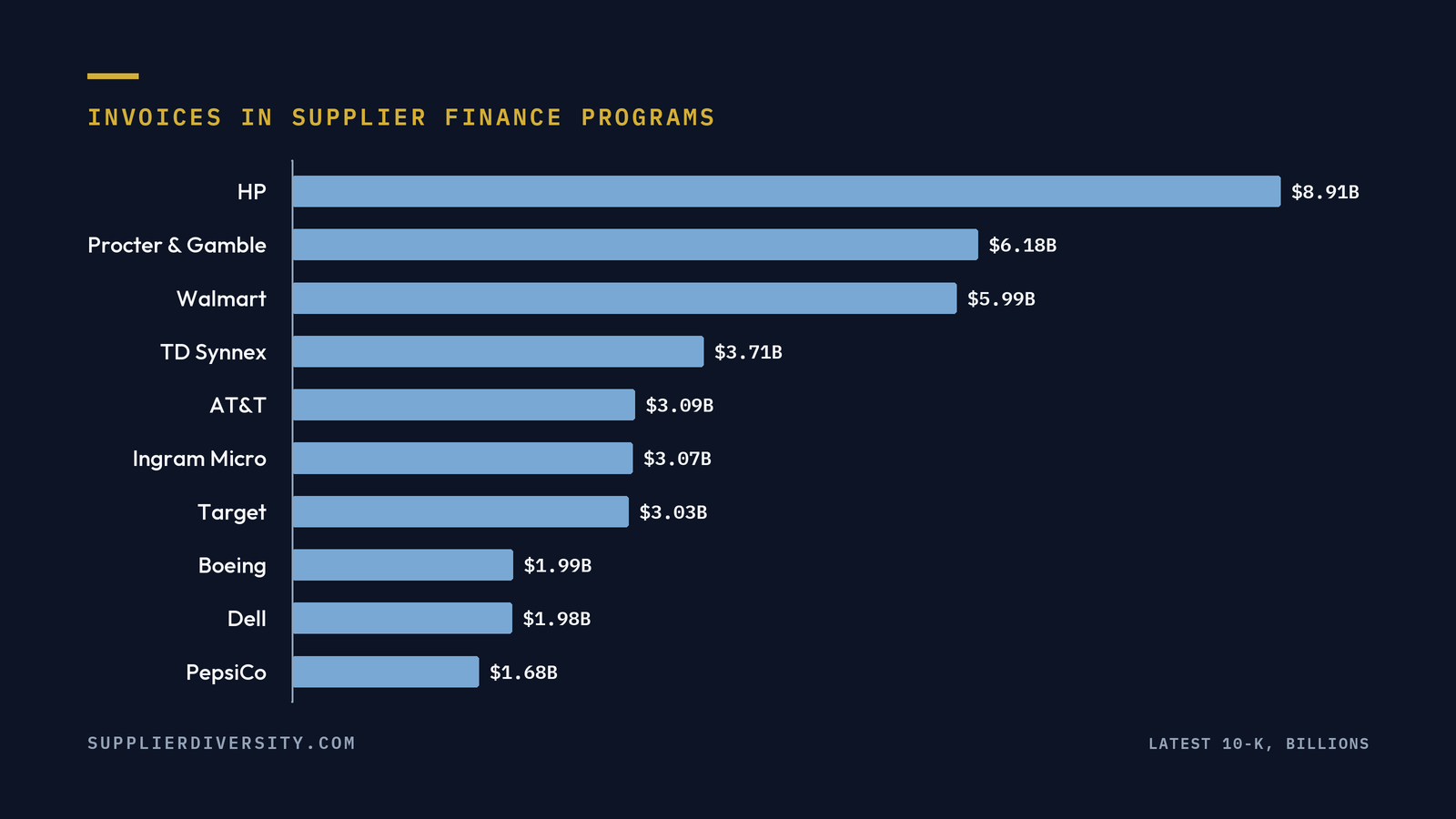
If you sell to a large company, there is a good chance its payables team will offer to pay you early through a bank. Companies that run these supplier finance programs report how much is sitting in them. We pulled the tagged figures from the latest annual report (10-K) of every public company in the 2026 Fortune 100 and read the supplier finance note in each of the 30 filings that report a balance, on November 16, 2026.
- 30 of the Fortune 100 report a balance, and one more (RTX) describes a program without one. At their latest fiscal year end, $52.2 billion of supplier invoices that these 30 companies had confirmed but not yet paid were in their programs, up from $49.0 billion a year earlier.
- That is not the amount suppliers sold to banks. HP had $8.9 billion of confirmed invoices in its programs, but says suppliers had elected to sell only $0.1 billion of them.
- $290 billion of supplier invoices were confirmed into these programs over a year, across all 30.
- 20 of the 30 state their payment terms, and they run to 180 days. Procter & Gamble says its terms for suppliers in its program "generally range from 60 to 180 days." Target, Coca-Cola and Tyson Foods cite 120 days.
The company-by-company table, with each filing linked and how each company measures its balance, is a free CSV download. The figures are 10-K year-end balances; some companies report newer, higher balances in their quarterly filings.
How a supplier finance program works
The buyer approves your invoice and commits to pay it in full on the due date. A bank, often through a platform the buyer arranges, offers to buy that approved invoice from you before then, at a discount. If you sell, the buyer pays the bank on the due date; if you do not, the buyer pays you.
The bank prices the discount on the buyer's credit, not yours. Procter & Gamble's 10-K says the banks "allow the suppliers to utilize the Company's creditworthiness in establishing credit spreads and associated costs." Coca-Cola says its suppliers sell receivables "on a non-recourse basis at a rate that leverages our credit rating." AT&T says the discounted price "is based on a variable rate that is indexed to the overnight borrowing rate."
The terms of the sale are between you and the bank. Verizon says suppliers "negotiate the terms directly with the financial institution and we have no involvement in establishing those terms." Dell says the same.
What the 30 companies report
| Company (2026 Fortune rank) | Balance at year end | A year earlier | Invoices confirmed in the year | Payment terms the 10-K states |
|---|---|---|---|---|
| HP (84) | $8.91 B | $7.81 B | $44.02 B | Not stated; suppliers had sold $0.1 B of the balance |
| Procter & Gamble (54) | $6.18 B | $5.79 B | $18.11 B | "generally range from 60 to 180 days" |
| Walmart (2) | $5.99 B | $5.72 B | $40.34 B | "generally range between 30 and 90 days" |
| TD Synnex (74) | $3.71 B | $3.17 B | $13.77 B | Not stated |
| AT&T (35) | $3.09 B | $2.50 B | $17.94 B (invoices received) | Pays the bank "generally within 90 days of receipt of the invoice" |
| Ingram Micro (90) | $3.07 B | $2.39 B | $12.38 B | "typically range from 30 to 90 days" |
| Target (42) | $3.03 B | $3.67 B | $11.43 B | "up to 120 days from the invoice date" |
| Boeing (47) | $1.99 B | $2.70 B | $10.95 B (additions) | Majority due "within 30 to 90 days" |
| Dell Technologies (41) | $1.98 B | $1.37 B | $6.05 B | "vary and do not exceed 100 days" |
| PepsiCo (46) | $1.68 B | $1.48 B | $6.67 B | Majority "generally range from 60 to 90 days" |
The other twenty, in order of balance: Cigna, Lowe's, Coca-Cola, General Motors, Nike, Caterpillar, Johnson & Johnson, Charter, Verizon, Pfizer, UPS, Home Depot, ADM, Kroger, Tyson Foods, Ford, Uber (its freight unit), IBM, FedEx and Sysco. All are in the CSV. Seventeen of the 30 reported a higher balance than a year earlier, twelve lower (led by Boeing, down $0.71 billion, and Target, down $0.64 billion), and Nike was flat at $1.1 billion.
The balances are not measured the same way
Use the totals as a sense of scale, not a league table:
- Most companies report confirmed invoices, whether or not a supplier sold them. HP's $8.9 billion is confirmed invoices; $0.1 billion was sold. Tyson says amounts financed "may be lower than amounts outstanding."
- Some report only what was sold. Lowe's reports obligations suppliers "financed," and ADM reports obligations suppliers "had elected to sell."
- Others report eligibility. Target reports vendor obligations eligible for early payment and says actual early payments "have historically been lower." General Motors reports "eligible balances." FedEx reports what suppliers were approved to sell, and says it guarantees those payments to the banks.
- The yearly flow mixes bases too. AT&T reports invoices received, Boeing additions and Lowe's obligations financed during the year.
- Fiscal years differ. Tyson filed its 10-K on November 16, 2026 for the year ended October 3, 2026; HP's latest is for the year ended October 31, 2025.
And absence is not proof. The other 70 include banks, insurers, mutual companies that file no 10-K, and companies that may run a program without reporting a balance. We did not find one for them; we do not say they have no program.
Price the offer before you take it
An early-payment offer is a discount on your invoice. To compare it with your other options, turn it into a simple annual rate (not compounded):
Simple annual rate = discount ÷ (1 − discount) × 365 ÷ days paid early
| Offer | Simple annual rate |
|---|---|
| 1.0% discount, paid 60 days early | 6.1% |
| 2.0% discount, paid 90 days early | 8.3% |
| 0.5% discount, paid 30 days early | 6.1% |
Then compare it fairly:
- Use all-in costs on both sides. Add any platform fee to the early-pay discount; add commitment and other fees to your credit line's rate.
- Count the risk you shed. If the sale is non-recourse, the bank, not you, waits on the buyer for that invoice. A drawn credit line leaves the receivable, and its risk, with you.
- If you would not otherwise borrow, compare the rate with what the cash earns or saves you in your business, not with a loan rate.
A factoring company buying the same invoice prices your customer's credit and its own costs; our factoring guide shows how those fees are quoted.
Before you sign up: five questions
- Is the sale non-recourse? Ford, Cigna, Coca-Cola and Verizon describe suppliers selling receivables on a non-recourse basis. Read the bank's agreement for what happens if the buyer later disputes the invoice.
- Are your terms being lengthened at the same time? The companies say joining does not change what they owe you or when: PepsiCo says suppliers' "amounts due and scheduled payment terms, are not impacted," and P&G says the same. But extending terms often travels alongside these programs. Lowe's says its goal is "to capture overall savings in the form of pricing, payment terms, or vendor funding," and AT&T says it seeks "90-day or greater terms, while providing suppliers with access to bank facilities that permit earlier payment at their cost." Negotiate the terms first, then decide on early pay.
- How is the discount rate set and reset? Ask whether it floats with a benchmark plus a spread, as AT&T's does, and how often it changes.
- Can the program end? HP and its banks "may terminate the agreement upon at least 30 days notice"; Target's arrangements can be ended "with notice ranging up to 120 days." Do not build your cash plan on a program you do not control.
- Can you choose invoice by invoice? Walmart says participation "is optional and solely up to the supplier," and Home Depot and Lowe's describe it as the supplier's choice. Confirm you can sell some invoices and hold others.
A copy-ready note to your customer's payables team
Subject: Early payment options for our invoices
We supply [category] under PO or contract [number]. Do you offer a supplier finance or early payment program? If so, please send the program name, the participating bank or platform, how the discount rate is set, whether sales are non-recourse, any platform fees, the onboarding steps, and how much notice is given if the program changes. Our standard terms with you remain net [days].
Where this fits in your financing plan
Early pay only works on invoices a large buyer has approved. Before the first purchase order, most suppliers still need working capital to build or deliver. Our guides to working capital for suppliers, contract financing and financing options for certified businesses cover the steps before the invoice, and the lender directory lists banks and CDFIs with programs for small and diverse firms. If Walmart or P&G is your target account, start with our Walmart and Procter & Gamble supplier guides.
How we built this
- Universe: the 100 largest companies in the 2026 Fortune 500, read November 16, 2026. Mutual insurers and other companies that do not file with the SEC have no 10-K and are not covered.
- Balances and flows: each company's latest 10-K, from the SEC's XBRL company facts for the supplier finance program balance and its yearly rollforward, or the 10-K text where no annual value was tagged (AT&T, Boeing, Lowe's, FedEx). We then read the supplier finance note in each of the 30 filings for payment terms and how the balance is measured; IBM's note is in the annual report filed as an exhibit to its 10-K. Each row in the CSV links to the filing.
- Computed by us: totals, year-over-year changes and the annual-rate examples.
- Not covered: private companies, the program RTX describes without an amount, balances reported after the latest 10-K, and the discount rates banks actually charge, which no 10-K we read disclosed.
Sources, checked November 16, 2026: the 30 annual reports linked in the CSV, on sec.gov; the 2026 Fortune 500 list.