Most US companies report supplier diversity spend because they choose to. A smaller group has to, by statute or regulation, on fixed dates, to a named regulator, and in several cases with a penalty for filing late. We read each rule below on its official text on November 16, 2026:
- Federal prime contractors with a small business subcontracting plan (contracts over $900,000, or $2 million for construction) report subcontract awards twice a year plus an annual summary. The dates and the system depend on which version of the clause your contract carries: 30 days after each period in eSRS under the codified FAR clause, or 45 days in SAM.gov under the FAR overhaul deviation, which Defense contracting officers have used since February 1, 2026.
- California utilities, telephone and wireless companies with more than $25 million in California revenue, and community choice aggregators with more than $15 million, file with the CPUC by March 1.
- California insurers with $75 million or more in California premiums report every two years, on July 1 of even years. The next is July 1, 2028.
- California hospitals with $50 million or more in operating expenses ($25 million inside a hospital system) file a plan with HCAI by July 1 every year.
- Illinois gas, electric and water utilities with at least 100,000 customers report to the Illinois Commerce Commission by April 15.
- Illinois insurance companies with at least $50 million in assets report to the Department of Insurance by April 1, and from 2027 in a format the Department sets.
- State DOTs, transit agencies and airports that receive USDOT money report DBE participation at the intervals their USDOT operating administration sets and enter bidders list data by December 1. Since October 3, 2025 they may not set DBE contract goals or count DBE participation until their state's certification program finishes its reevaluation.
The whole table, with thresholds, contents, penalties, sources and the date we read each one, is a free CSV download.
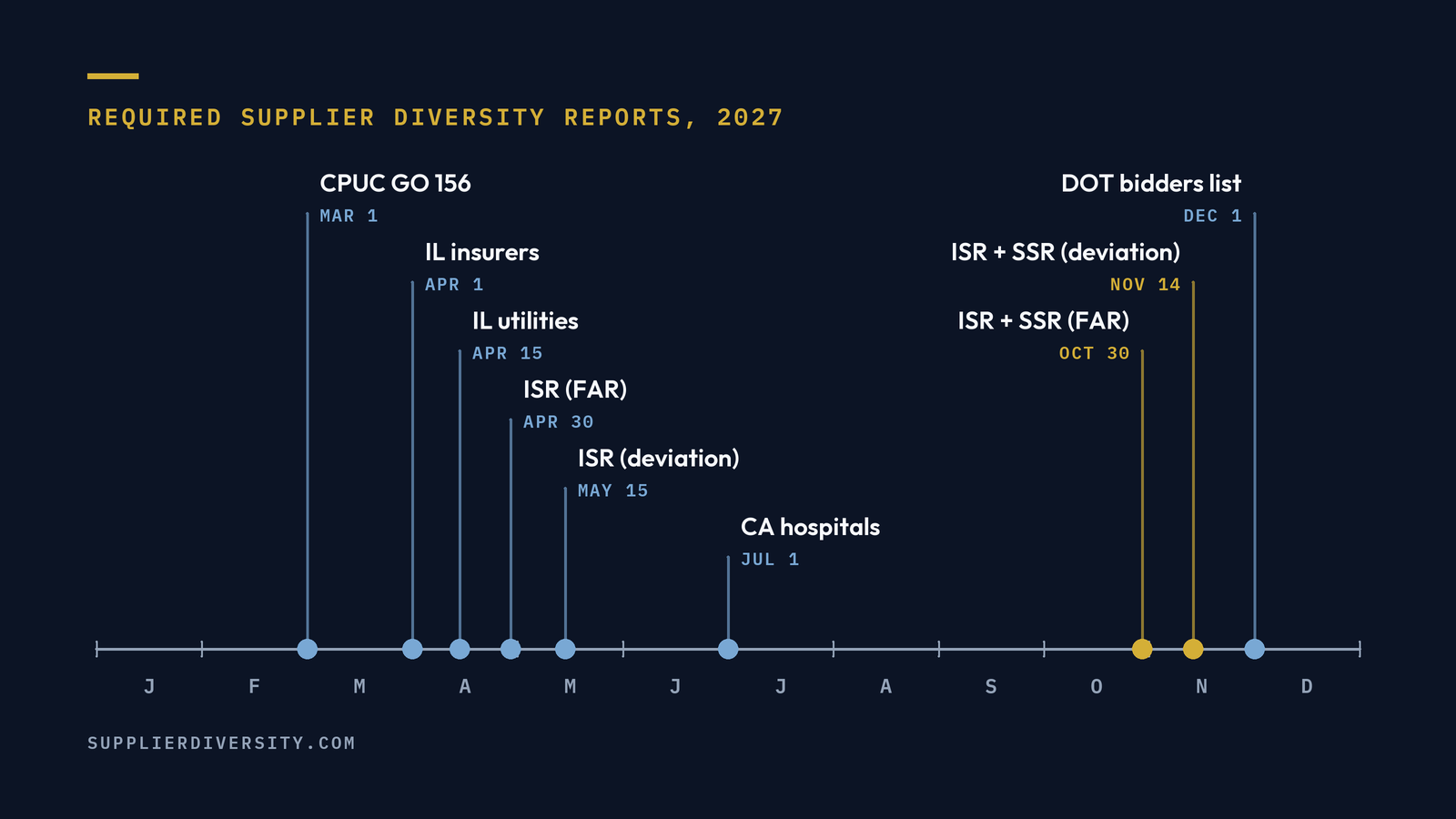
The 2027 filing calendar
| Date (2027) | Day | Report | Filed with |
|---|---|---|---|
| March 1 | Monday | CPUC General Order 156 annual report and plan | California Public Utilities Commission |
| April 1 | Thursday | Insurance company supplier diversity report (first year in the Department's format) | Illinois Department of Insurance |
| April 15 | Thursday | Utility supplier diversity report | Illinois Commerce Commission |
| April 30 | Friday | Federal Individual Subcontract Report, period ending March 31 (codified clause) | Contracting officer, in eSRS |
| May 15 | Saturday | Federal ISR, period ending March 31 (FAR overhaul deviation clause) | Contracting officer, in SAM.gov |
| July 1 | Thursday | Hospital supplier diversity plan | HCAI, in the HDC system |
| October 30 | Saturday | Federal ISR, period ending September 30, and Summary Subcontract Report (codified clause) | Contracting officer, in eSRS |
| November 14 | Sunday | Federal ISR, period ending September 30, and Summary Subcontract Report (deviation clause) | Contracting officer, in SAM.gov |
| December 1 | Wednesday | Bidders list data for the prior fiscal year's DOT-assisted contracts | The USDOT operating administration's system |
Three of the federal dates fall on a weekend; file by the Friday before rather than count on an extension. California insurers have no filing in 2027.
Which federal clause do you have? Open your contract's clause list and find 52.219-9. A "(JAN 2025)" or earlier date means the codified clause: eSRS, 30 days, October 30. A "(Deviation)" version means the FAR overhaul text: SAM.gov's Subcontracting Plan Reporting, 45 days, November 14. Both versions also require a final individual report after the contract is complete (within 30 or 45 days, respectively). If you hold both kinds of contracts, you keep both calendars.
What each report must contain
The reports ask for overlapping facts. A compliance team that captures these fields once, at the vendor master and the invoice, can produce every report below. We mapped each requirement from the rule's list of required contents.
| What the rule asks for | Federal plan and reports | CPUC GO 156 | CA insurers | CA hospitals | IL utilities | IL insurers |
|---|---|---|---|---|---|---|
| Supplier diversity policy statement | Yes | Yes | ||||
| Goals | Yes | Yes | Yes | Yes | Yes | |
| Spend by business category | Yes | Yes | Yes | Yes | Yes | |
| Subcontracting or Tier 2 | Yes | Yes | Yes | |||
| Outreach description | Yes | Yes | Yes | Yes | Yes | Yes |
| What you plan to buy (types, codes, or a buying plan) | Yes | Yes | Yes | |||
| Certifications you accept | Yes | Yes | ||||
| Point of contact for suppliers | Yes | Yes | Yes | Yes |
The federal plan names an internal program administrator, not a contact for suppliers.
The categories differ by rule. Store each supplier's certification and its issuer, not a yes/no flag:
| Rule | Categories it counts |
|---|---|
| Federal subcontracting plans | Small, veteran-owned small, service-disabled veteran-owned small, HUBZone, small disadvantaged and women-owned small businesses |
| CPUC GO 156 | Women, minority, disabled veteran and LGBT business enterprises, plus persons with disabilities enterprises (reported since March 2024) |
| California insurers | Minority, women, LGBT, persons with disabilities, veteran and disabled veteran business enterprises |
| California hospitals | Minority, women, LGBT and disabled veteran business enterprises, Tier 1 and Tier 2 |
| Illinois utilities | Female-owned, minority-owned, veteran-owned and small business enterprises |
| Illinois insurers | Minority-, women-, LGBT- and veteran-owned, by the certifications the company accepts |
Three details catch teams out:
- California geography. The insurer rule asks for spend with suppliers headquartered in California and, separately, with a majority-California workforce, each by category; the hospital rule asks for the majority-California workforce figure. A national total does not answer either question.
- Only verified suppliers count under GO 156. The CPUC counts women-, minority-, LGBT- and disability-owned suppliers verified through its Supplier Clearinghouse ("eligible suppliers"); disabled veteran businesses are handled under a separate section. A supplier's NMSDC or WBENC certificate alone does not put it in a utility's GO 156 numbers.
- Illinois wants a buying forecast. The utility statute asks for a buying plan for the next 6 to 18 months, by NAICS code or procurement category, written so a supplier can see what is coming.
Penalties and extensions
| Rule | What happens if you miss it |
|---|---|
| Federal subcontracting plans | Failing to comply in good faith with the plan is a material breach of the contract, and failing to make a good faith effort results in liquidated damages (FAR 19.702(c)) |
| CPUC GO 156 | "No penalty shall be imposed" for missing procurement goals (section 8.13); the annual report itself is required |
| California insurers | A civil penalty of up to $5,000, or up to $10,000 if willful; the commissioner may grant a 30-day extension |
| California hospitals | A civil penalty of $100 a day; HCAI may grant a 30-day extension |
| Illinois utilities | Section 5-117 sets no penalty of its own, but the Public Utilities Act's general penalty (220 ILCS 5/5-202) covers a utility that fails to comply with any provision of the Act: up to $30,000 per offense for utilities other than small ones |
| Illinois insurers | Section 155.49 sets no penalty; we did not review the Insurance Code's general enforcement provisions |
Scope details worth checking
- California insurers: an insurer in a holding company group may file once for the group, and an insurer that does not buy goods or services in California files an attestation instead (Insurance Code 927.2). The threshold is $75 million, in the statute and on the Department's 2026 survey page; an older Department survey page still shows $100 million.
- California hospitals: operating expenses for the threshold exclude physician professional fees (Health and Safety Code 1339.86(h)).
- DOT-assisted contracts: the pause on DBE goals and counting (49 CFR 26.51(h) and 26.55(i)) lasts until the certification program covering the recipient finishes reevaluating its DBEs. Primes still supply the bidder data with their bids. Our DBE guide tracks the 2026 rule.
What the published reports show
The CPUC, HCAI, the ICC and the Illinois Department of Insurance publish what companies file, which makes these mandated reports one of the few public, comparable sources of corporate diverse spend. The CPUC's 40th annual report to the Legislature (August 2026) puts 2025 spend by California's investor-owned utilities with diverse suppliers at $13.15 billion, 28.8% of procurement, against the program's 23% overall goal. Our energy and utilities guide covers what that means for a supplier.
Are you in scope? A five-minute check
- Do you hold a federal contract with a small business subcontracting plan? Find the clause version (above), then see our ISR and SSR guide and FAR 52.219-9 guide.
- Are you a CPUC-regulated electric, gas, water, telephone or wireless company, an electric service provider or a community choice aggregator? Check California revenue against $15 million and $25 million.
- Are you an admitted insurer in California? Check California written premiums against $75 million, and confirm the Government Relations contact the Department has on file.
- Do you operate a licensed California hospital? Check operating expenses (without physician fees) against $50 million, or $25 million if you belong to a system.
- Are you an Illinois gas, electric or water utility with 100,000 customers, or an insurer authorized in Illinois with $50 million in assets? Both file in the spring.
- Do you receive USDOT funds as a state DOT, transit agency or airport? DBE reporting and the bidders list apply.
If none apply, your reporting is voluntary, and the useful standard is what your customers ask for. Large buyers ask suppliers for Tier 2 data; our Tier 2 program setup guide and the general reporting guide cover that side.
A copy-ready request to your suppliers
Every rule above depends on knowing which suppliers are certified, by whom, and through when. This request collects it in one pass:
Subject: Certification and ownership information for our supplier records
We are updating our supplier records for required and voluntary supplier diversity reporting. Please reply with: (1) any small business or diverse business certification you hold (for example SBA 8(a), HUBZone, WOSB or SDVOSB; NMSDC, WBENC, NGLCC, Disability:IN; a state certification or CPUC Supplier Clearinghouse verification), the issuing body, the certificate number and the expiration date; (2) the location of your headquarters and, if a majority of your workforce is in one state, which state; (3) your primary NAICS code. A copy of each current certificate is helpful. This does not affect any current order or payment.
How we built this
- Read on the official text, November 16, 2026: FAR 52.219-9 and FAR 19.702 (eCFR, current through November 13, 2026); the FAR overhaul Part 52 and Part 19 deviation text and the DoD Part 19 class deviation; California Public Utilities Code 8283, Insurance Code 927.2 and Health and Safety Code 1339.87; the CPUC supplier diversity program and General Order 156; the Department of Insurance 2026 CAIDS resources and Insurer Supplier Diversity pages; HCAI's hospital supplier diversity page; 220 ILCS 5/5-117 and 5/5-202; 215 ILCS 5/155.49; 49 CFR 26.11, 26.51 and 26.55.
- Computed by us: the 2027 calendar and weekdays, and the field matrix, built from each rule's list of required contents.
- Not covered: the Defense Department's comprehensive subcontracting plan test program, mentor-protégé reporting, rules in other states, and the contract-level utilization plans that states and cities attach to their own contracts (see our state guides). This page is a compliance map, not legal advice; confirm scope with counsel or the regulator before relying on it.
Sources, checked November 16, 2026: listed above, each read on the issuing government's own site.