The federal government sent $179.0 billion of prime contract dollars to small businesses in fiscal 2025, 27.58% of the total, against a statutory goal of 23%. SBA gave the government an overall A. That is the headline SBA published on June 25, 2026.
The data underneath it tell a harder story for anyone selling to the government. Small business prime dollars fell from $183.5 billion in fiscal 2024 to $179.0 billion, and the share from 28.76% to 27.58%. We read SBA's own scorecard data file for every agency and compared it with fiscal 2024:
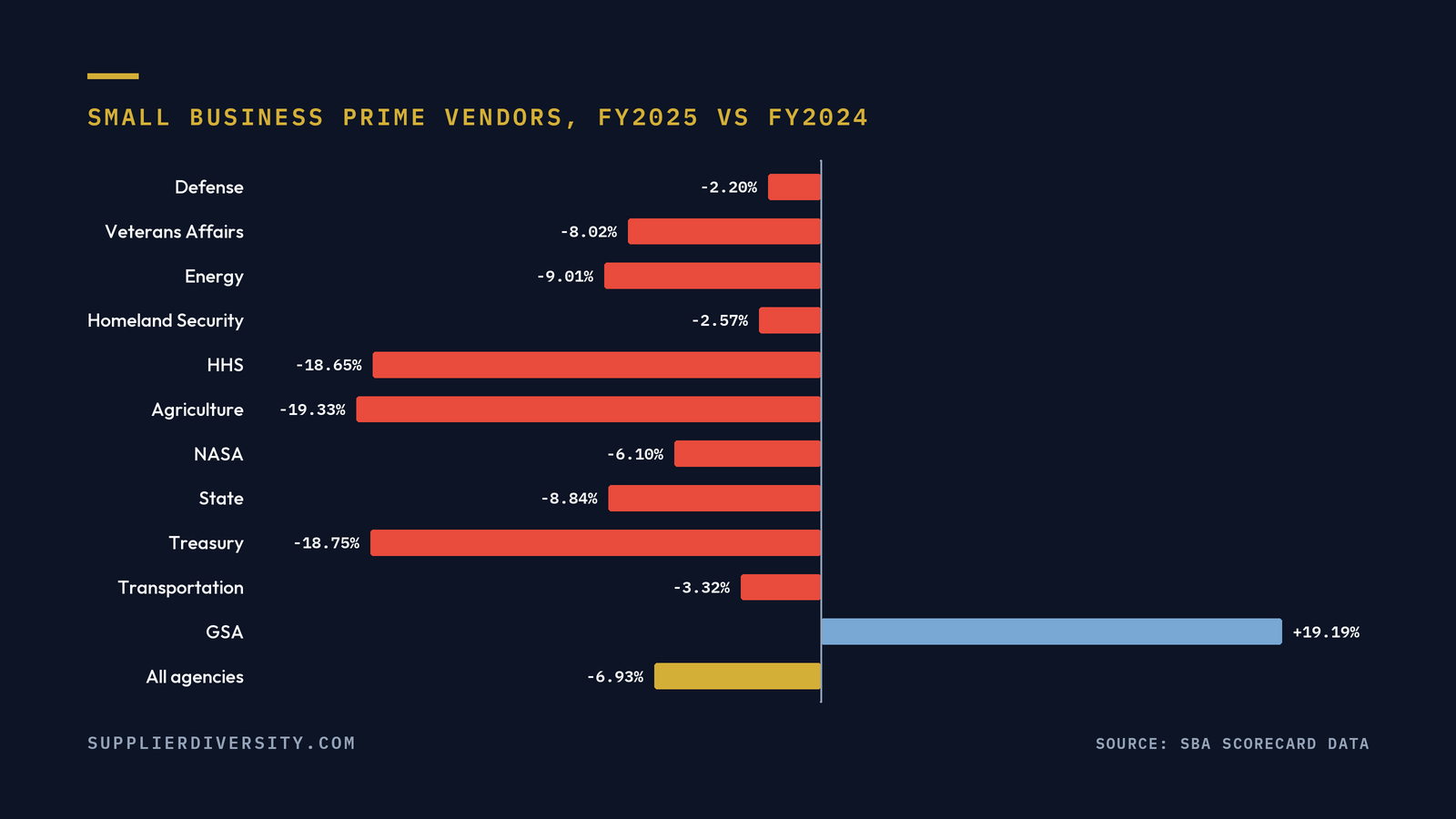
- Fewer small businesses are winning. The number of small businesses holding prime awards fell from 60,951 to 56,725, down 6.93%. It fell at 22 of the 23 agencies with a fiscal 2025 grade. Only GSA grew (up 19.19%).
- Prime contractors missed four of five subcontracting goals. Government-wide, small business subcontracting reached 32.65% against a 33.34% goal. Subcontracts to service-disabled veteran-owned firms reached 2.42% against a 5% goal, and 18 of 23 agencies missed that goal.
- The small disadvantaged business goal was cut from 13% to 5%. SDB prime share fell from 12.27% to 11.60%, still more than double the new goal, and the reset alone adds about 5.5 points to the government-wide score (see below).
- Women-owned and HUBZone firms missed again. WOSB prime share was 4.52% against 5%, and HUBZone 2.66% against 3%. Neither goal has been met in any of the five years SBA's file covers (fiscal 2021 to 2025). The service-disabled veteran-owned prime goal was met, at 5.01% against 5%.
The full agency table, with every goal, grade and vendor count, is a free CSV download.
What the grade measures, and what it hides
An agency's grade is a weighted score. Reproducing SBA's own component scores, prime contracting carries 50% of the grade, subcontracting 20%, a peer review of the agency's small business office 20% (SBA's scorecard page says it scores 22 requirements of 15 U.S.C. 644(k)), and the change in the number of small business vendors 10%. That last factor averages SBA's multipliers for five vendor categories, so it can run above 10 points (GSA scored 12.60); SBA's scoring table gives a decline of 10% or more the lowest multiplier, 0.7. Government-wide, that arithmetic gives 59.93 + 17.94 + 17.85 + 9.00 = 104.72%, which is the score SBA published for the A.
Three consequences matter if you sell to the government or hold a subcontracting plan:
- An agency can miss its own small business goal and still get an A. Seven agencies landed below their prime small business goal; five of them (Veterans Affairs, Homeland Security, Transportation, Education and the Nuclear Regulatory Commission) still earned an A, and SSA and NSF earned a B.
- A strong category offsets a weak one. In SBA's data each category is scored against its goal, and SBA's footnote caps each result at 200%. Government-wide SDB share of 11.60% against a 5% goal scores the cap, which helps carry the missed HUBZone and WOSB goals.
- Fiscal 2025 grades are not comparable with fiscal 2024's. In fiscal 2024, agency SDB goals ranged from 8.15% to 60.5% and 14 agencies missed theirs. In fiscal 2025 every SDB goal is 5%: none missed, and 19 of the 23 graded agencies hit the 200% cap. Scored against the old 13% government-wide goal, the fiscal 2025 government-wide score would be about 99.2 instead of 104.72 (our arithmetic: 11.60 ÷ 13 in place of the cap). SBA publishes no grade cutoffs, so we do not say whether any grade would change.
The ten largest small business buyers
Defense alone accounts for 55.9% of small business prime dollars. SBA's fiscal 2025 file lists it as the Department of War.
| Agency | Small business prime dollars, FY2025 (FY2024) | Share of agency dollars | Agency's goal | FY2025 grade (FY2024) | Small business vendors, change |
|---|---|---|---|---|---|
| Defense (listed as War) | $100.1 B ($97.1 B) | 25.71% | 23.17% | A (A) | 29,584 to 28,932, -2.20% |
| Veterans Affairs | $12.6 B ($12.4 B) | 26.87% | 29.00% | A (A) | 8,196 to 7,539, -8.02% |
| Energy | $10.4 B ($10.7 B) | 22.02% | 17.03% | A (A) | 899 to 818, -9.01% |
| Homeland Security | $9.9 B ($9.8 B) | 31.07% | 36.50% | A (A) | 5,056 to 4,926, -2.57% |
| Health and Human Services | $7.8 B ($9.4 B) | 25.68% | 24.50% | A (B) | 4,139 to 3,367, -18.65% |
| Agriculture | $7.3 B ($8.6 B) | 74.05% | 58.00% | A (A) | 7,958 to 6,420, -19.33% |
| NASA | $3.9 B ($3.6 B) | 18.89% | 18.30% | B (B) | 1,673 to 1,571, -6.10% |
| State | $3.5 B ($4.4 B) | 35.32% | 34.50% | A (A+) | 1,877 to 1,711, -8.84% |
| Treasury | $3.3 B ($3.7 B) | 38.32% | 36.75% | A (A+) | 1,771 to 1,439, -18.75% |
| Transportation | $3.1 B ($3.1 B) | 32.80% | 34.00% | A (A) | 1,960 to 1,895, -3.32% |
The vendor counts are SBA's count of distinct small businesses receiving prime awards at each agency. Read the two columns together. At Defense, Veterans Affairs, Homeland Security and NASA, small business dollars held or rose while the vendor count fell: the same or more money went to fewer firms. At HHS, Agriculture, State and Treasury, both fell: fewer firms and fewer dollars.
Where the small business vendor base shrank
The steepest drops among the larger buyers came at Agriculture (down 19.33%), Treasury (down 18.75%) and Health and Human Services (down 18.65%). Among smaller agencies, SBA itself fell 35.58%, NSF 29.21%, HUD 21.45% and OPM 20.14%.
The decline reached almost every category. Government-wide, women-owned small business vendors fell 7.44% (12,584 to 11,648), small disadvantaged businesses 4.71% and HUBZone firms 2.96%. Service-disabled veteran-owned vendors were the exception, up 1.59% (5,778 to 5,870).
Subcontracting: what primes delivered
Prime contractors with small business subcontracting plans placed $93.7 billion with small businesses in fiscal 2025, up from $90.7 billion. The share still fell, from 36.02% to 32.65%, so total subcontracting grew faster than the small business portion.
| Subcontracting category, government-wide | FY2025 achieved | Goal | Met? |
|---|---|---|---|
| Small business | 32.65% | 33.34% | No |
| Small disadvantaged business | 4.81% | 5.00% | No |
| Women-owned small business | 5.67% | 5.00% | Yes |
| Service-disabled veteran-owned | 2.42% | 5.00% | No |
| HUBZone | 1.54% | 3.00% | No |
Agency by agency, Treasury and SBA met none of their five subcontracting goals (SBA's own small business subcontract base is $103.3 thousand). Homeland Security, Commerce and OPM met all five. The subcontract money is concentrated: small business subcontracts under Defense contracts came to $64.3 billion (32.78% against a 30% goal), GSA's to $10.1 billion and VA's to $6.8 billion, while Treasury's were $40.9 million (15.50% against a 25% goal) and Agriculture's $122.3 million.
For a prime contractor this is the useful number. Government-wide, primes delivered about half of the SDVOSB and HUBZone subcontracting goals. Our read: those are the categories most likely to draw questions when a subcontracting plan is negotiated or a subcontract report is reviewed.
What changed in the programs behind the numbers
- 8(a): $24.3 billion, 3.7% of prime dollars, down $1.5 billion from fiscal 2024, per SBA's release. SBA's file attributes 67.2% of that $24.3 billion to entity-owned 8(a) firms and 32.8% to individually owned firms, and 59.7% to sole-source awards. SBA's scorecard page puts it this way: tribal entity-owned firms "are 16% of participants" yet "receive nearly 70% of 8(a) dollars."
- Small disadvantaged business goal: 5% for fiscal 2025, down from 13% in fiscal 2024's file.
- Set-aside dollars, as SBA's file labels them: $71.75 billion in small business set-asides, $14.34 billion in SDVOSB set-asides (97.4% competitive), $2.91 billion in HUBZone and $1.98 billion in WOSB set-asides.
What to do with this, by who you are
If you are a small business picking federal targets:
- Weigh three signals together, not one: small business dollars, the vendor count and the agency's share against its goal. Defense passes all three (dollars up to $100.1 billion, vendors down only 2.20%, share above goal). Homeland Security kept its vendor count but its small business share fell from 38.40% to 31.07%, below its 36.50% goal.
- Look for the subcontract money where it is. Small business subcontracts are largest under Defense ($64.3 billion), GSA ($10.1 billion) and VA ($6.8 billion) contracts; the subcontract finder lists primes with plans to fill. At Treasury and Agriculture the subcontract base is too small to be a strategy.
- If you are SDVOSB or HUBZone certified, say so in the first line of every prime outreach email. Primes missed those subcontracting goals by the widest margin.
If you are a prime contractor with a subcontracting plan:
- Use the fiscal 2025 agency results in the CSV as context when you negotiate your plan's goals, especially SDVOSB and HUBZone. Your obligation is the plan you sign: the FAR 52.219-9 guide covers what a contracting officer can reject, and FAR 19.702(c) makes a failure to make a good faith effort grounds for liquidated damages.
- Measure yourself against your own plan's goals, not the agency's averages, and document the good-faith effort as you go, not at the compliance review. Check which version of the subcontracting plan clause your contract carries: the reporting dates and system differ (see our reporting requirements guide).
- Benchmark against peers with our subcontracting goals analysis and the steps that close a shortfall.
A copy-ready line for a capture or business development update:
SBA's FY2025 scorecard shows small business prime vendors down 6.93% government-wide (60,951 to 56,725) and primes below goal on four of five subcontracting categories, with SDVOSB at 2.42% against 5% and HUBZone at 1.54% against 3%. Source: SBA scorecard data, sba.gov, read November 16, 2026.
If you win a first federal award or subcontract, you carry payroll and materials until the invoice is paid; our guide to factoring government invoices covers how that financing is priced and how assignment of claims works on a federal receivable.
How we built this
- Source: SBA's scorecard data files for fiscal 2025 and fiscal 2024, the JSON behind SBA's scorecard summary page, downloaded November 16, 2026. SBA's footnotes say prime data were retrieved February 20, 2026 and subcontracting data January 30, 2026.
- Computed by us: goals met per agency, the agency rankings, the defense share of small business dollars (100.1 / 179.0), vendor count and dollar changes against fiscal 2024, the grade weights (reproduced from SBA's component scores, not from a methodology document), and the SDB rescoring.
- Taken as SBA states them: dollar totals, percentages, goals, grades, vendor counts, and the 8(a) and SDB figures in SBA's June 25, 2026 release and on its scorecard details page.
- Not covered: why any agency's numbers moved, SBA's grade cutoffs, and USAID, which has no fiscal 2025 grade in SBA's table. Federal spending data keep changing after the year closes; our federal spending database shows the live USAspending totals, which will not match the scorecard exactly.
Sources, checked November 16, 2026: SBA scorecard summary; SBA scorecard data, FY2025 and FY2024; SBA news release 26-64, June 25, 2026; FAR 52.219-9 (eCFR).