Fifty-nine of the companies on the 2026 Fortune 100 have published a supplier diversity spend figure at some point. We read the supplier pages, sustainability and impact reports, and SEC filings of all 100 on November 16, 2026, and recorded the latest figure each one publishes, in its own words.
- 12 of the 100 still publish a spend figure for 2024 or 2025 in their newest report or supplier page.
- Only 4 of those 12 limit it to diverse- or disadvantaged-owned suppliers: Amazon, ConocoPhillips, Kroger and New York Life. The other 8 include small businesses or define the category to include them.
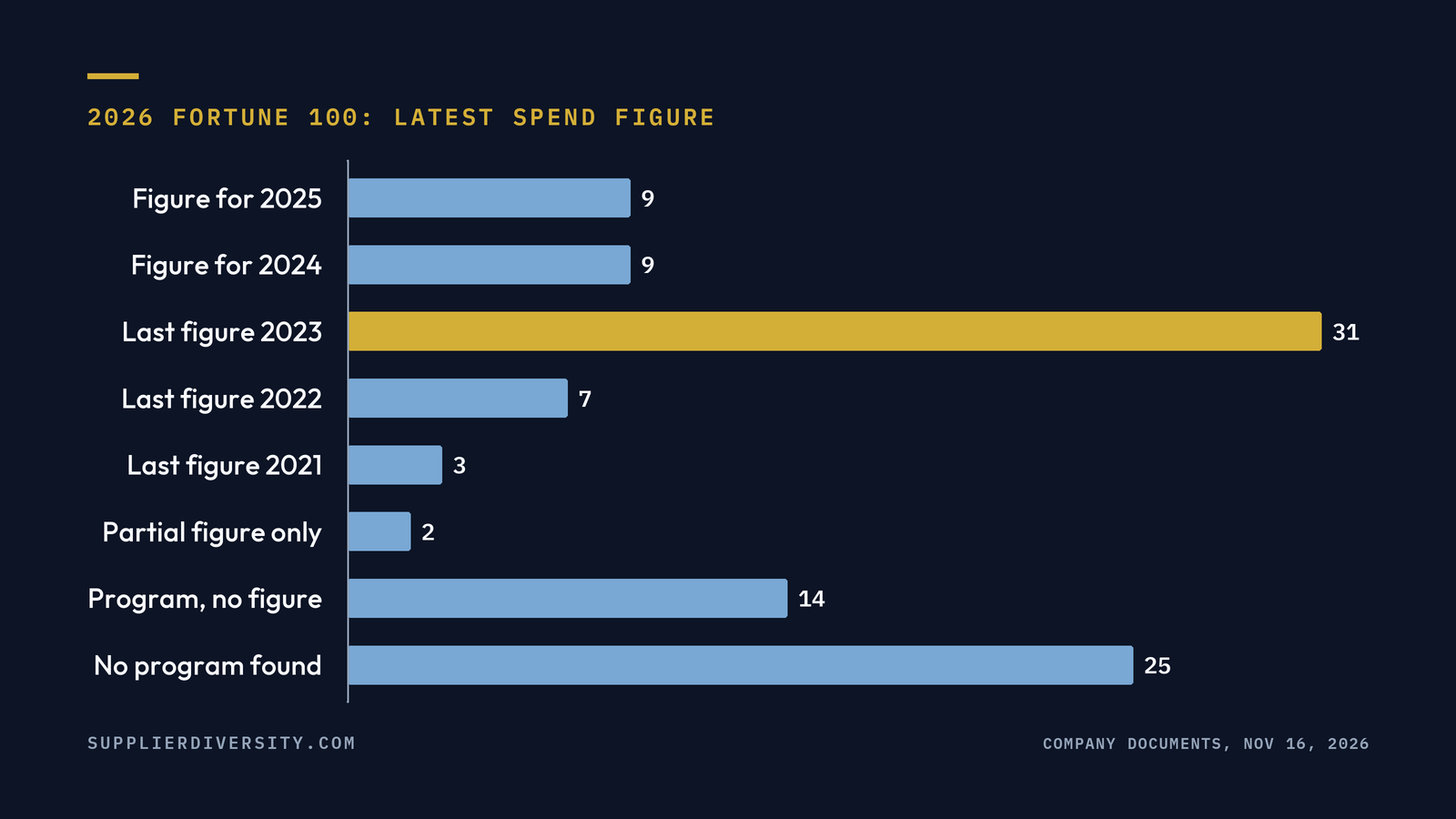
- For 31 companies, the last published figure is for 2023. That is the most common last year by far: more than half of the 59 companies that have ever published a figure stopped there.
- 6 companies published a 2024 figure and have since dropped it from their newest report or data page: Walmart, ExxonMobil, Marathon Petroleum, Sysco, Intel and Microsoft.
- Most program pages now use another name. Of the 42 we could load, most call the program supplier inclusion, supplier engagement, supplier development or a small business program.
Every company's row, with the figure, the year, what it counts, the document and a verbatim quote, is a free CSV download.
The 12 that still publish a recent figure
| Company (2026 rank) | Latest figure | Year | What it counts |
|---|---|---|---|
| Amazon (1) | $10.5 billion | 2025 | Tier 1 spend with disadvantaged-owned businesses certified by SBA, the Department of Transportation and other agencies |
| Target (42) | $4.42 billion | FY2025 | Small and diverse, Tier 1, U.S.; FY2024 was $2.93 billion, diverse only |
| Cencora (10) | $3.6 billion | FY2025 | "Small and Disadvantaged Businesses" |
| Kroger (27) | $3.13 billion | FY2024 | Diverse-owned, 837 certified suppliers |
| JPMorgan Chase (12) | about $2.9 billion | 2025 | Tier 1 small and/or diverse, of about $25 billion total procurement |
| ConocoPhillips (75) | $1.26 billion | 2025 | Diverse-owned, U.S.; small business reported separately ($1.09 billion) |
| Cigna (14) | about $1.2 billion | 2025 | Tier 1 indirect spend with certified business enterprises, which include small businesses; $1.6 billion in all |
| Elevance Health (18) | more than $1.2 billion | 2024 | "Diverse suppliers" in its Supplier Development program, which covers HUBZone, small and diverse-owned businesses |
| Centene (19) | $830 million | 2025 | Its Small Business Growth Initiative; the same figure it gave for 2024 |
| Humana (34) | $405 million | 2025 | Diverse, HUBZone and small; 6.96% of total supplier spend |
| Phillips 66 (29) | $165 million | 2025 | Tier 1 small and diverse; the 2026 report prints no year for the figure |
| New York Life (62) | $149.7 million | 2024 | "Total Inclusive Procurement Spend," with a footnote defining a diverse business; the 2025 column reads "Not Yet Available" |
Read the years and the definitions before comparing any two rows. Target's own footnote explains its jump: "In FY2025, we expanded our calculation scope to include both diverse and small business enterprises. Prior to FY2025, calculation scope included only diverse enterprises." JPMorgan Chase reported "approximately $2.3 billion directly with diverse suppliers" for 2023 in its 2023 annual report; its 2025 figure counts small and/or diverse suppliers.
When the numbers stopped
For the 59 companies that have published a company-wide figure, this is the year of the most recent one, as each company labels it:
| Latest figure is for | Companies |
|---|---|
| 2025 | 9 |
| 2024 | 9 |
| 2023 | 31 |
| 2022 | 7 |
| 2021 | 3 |
Six of the nine 2024 figures are no longer in the company's newest report or data page (Walmart, ExxonMobil, Marathon Petroleum, Sysco, Intel and Microsoft). Walmart's fiscal 2024 ended January 31, 2024. The other 41 companies: 14 have a program page but publish no figure we could find, 25 have no current program page and no figure in their recent reports, and HP and Tesla publish only a partial number (HP's 2025 table has a small business row and a veteran, HUBZone and other row with no total; Tesla's covers one Texas factory's program).
The 31 companies whose last figure is for 2023 include AT&T ($11.9 billion with underrepresented businesses), Verizon ($6.1 billion spent directly and indirectly with diverse suppliers), General Motors (about $5.6 billion with North American diverse Tier 1 suppliers), Comcast ($4.7 billion), Johnson & Johnson ($2.5 billion) and Bank of America (about $2 billion). In their newer reports, several report small business spend instead. AT&T's 2025 Sustainability Update reports "$3.5B Spent with small businesses across the U.S."
Relabeled, not always ended
Four of the largest companies kept reporting under a new label:
- Amazon. Its 2023 report gave $4.3 billion of "U.S. certified Tier 1 diversity spend." Its 2024 and 2025 reports describe Tier 1 spend with "Disadvantaged-owned Businesses (DOB) certified by the U.S. Small Business Administration, U.S. Department of Transportation, and other recognized agencies," which "increased from $9.7 billion in 2024 to $10.5 billion in 2025," under a program now called Supplier Development and Impact. Its 2025 report says those direct payments went to DOBs in eight countries.
- FedEx. Its 2024 ESG Report lists "Diverse supplier spending" of $18.80 billion for FY22 and $18.60 billion for FY23. Its 2025 report lists the same two values, $18.80 billion and $18.60 billion, as "Small business supplier spending."
- Boeing. Its 2024 report gives "Total spend on diverse and small business suppliers" of $5.4 billion for 2023 and $4.6 billion for 2022. Its 2025 report gives the same two values as "Total Spend on Small Business Suppliers."
- Merck (MSD). Its 2023/2024 report gives $3.6 billion of 2023 spend with "small and diverse Tier 1 and 2 suppliers." Its 2024/2025 report gives $4.0 billion for 2024 as "Global spend through our economic inclusion program," which the CEO letter calls spend "with small Tier 1 and 2 suppliers."
We count FedEx, Boeing and Merck at their last figure labeled by ownership, and Amazon at 2025, because its new category is still defined by ownership.
Others dropped a row they used to publish. ExxonMobil's metrics page carried U.S. certified Tier 1 diverse spend of $1.256 billion for 2024 in its earlier edition (we read an archived April 2026 copy); the current edition has no diverse-supplier rows. Marathon Petroleum's 2024 report lists $705 million of diverse supplier spend for 2024 (read from an archived copy, because Marathon's site blocks automated reading); its 2025 report does not.
What the programs are called now
We could load 42 program pages on November 16, 2026. The name each page uses for the program:
| Name on the page | Companies |
|---|---|
| "Supplier diversity" | CVS Health, ExxonMobil, JPMorgan Chase, Phillips 66, Humana, Procter & Gamble, Sysco, ConocoPhillips, TJX; Nike ("Business Diversity & Inclusion"); Morgan Stanley (page title "Supplier Diversity," main heading "Empowering Small Businesses") |
| Supplier inclusion | Walmart, Costco, Comcast, Allstate, Johnson & Johnson; Kroger (page title "Supplier Diversity & Inclusion"); Cigna ("Inclusive Supply Chain"); Cardinal Health ("Supply chain inclusion"); Microsoft ("Inclusive Buying"; its small business page is titled "Supplier diversity and small business at Microsoft"); Merck ("Economic Inclusion and Small Business Development") |
| Engagement, development and similar | UnitedHealth Group, McKesson, Cencora and Target ("Supplier Engagement"); Elevance Health and Eli Lilly ("Supplier Development"); Pfizer ("Supplier Discovery & Development"); Capital One ("Supplier Development and Opportunity"); Home Depot ("Supplier Pipeline"); General Motors ("Supplier Acceleration") |
| Small business | Verizon, Goldman Sachs, RTX, Lockheed Martin, General Dynamics, Tyson Foods, Bristol Myers Squibb |
| Other | Fannie Mae, Freddie Mac, Liberty Mutual, Chevron |
A renamed page is not a closed door. Kroger's renamed program still published a diverse-owned figure. Costco's Supplier Inclusion page says Costco "does not make purchasing decisions based on race/ethnicity, gender, age, or any other protected characteristic," and its 2025 sustainability report describes a program "to work with qualified small and diverse suppliers, including veterans." Read the page for what the company asks of a supplier today, not for the name.
Certifications these companies name
In the documents we read, published between 2021 and 2026, 38 of the 100 companies name at least one certifying body:
| Certifier | Companies naming it |
|---|---|
| NMSDC (minority-owned) | 32 |
| WBENC (women-owned) | 31 |
| NGLCC (LGBT-owned) | 27 |
| Disability:IN (disability-owned) | 26 |
| SBA programs or size standards | 21 |
| NVBDC (veteran-owned) | 17 |
| NaVOBA (veteran-owned) | 14 |
| WEConnect International | 11 |
| USPAACC (Asian American-owned) | 10 |
Treat these as the credentials large buyers have recognized, not a current list: some come from older or archived reports, and some companies name a certifier as a partner or membership rather than as a certification they accept. The CSV gives each company's own wording. In the same documents, 28 companies say they ask or encourage their prime suppliers to use or report diverse subcontractors, and 18 have published a Tier 2 dollar figure at some point.
If you sell to the Fortune 100
- Lead with what the program asks for now. Where the page has become a small business or engagement program, open with your size status (the SBA size standard for your NAICS code), capability and references; add your certification second.
- Keep the certification current. NMSDC and WBENC are the certifiers these companies have named most often. For regulated buyers, check the rule: a California utility counts a supplier toward its GO 156 report only if the CPUC's Supplier Clearinghouse has verified it, so an NMSDC or WBENC certificate alone is not enough there (see supplier diversity reporting requirements).
- Use the Tier 2 door. If a buyer has no open program, sell to its prime suppliers. Our Tier 2 setup guide shows what primes report.
- Find the right page in the corporate directory and check its program name against the table above before you register.
A copy-ready opening for a supplier registration or buyer email:
We are a [state]-based [NAICS code and description] business, small under SBA's size standard for that code, and certified by [certifier, certificate number, expiration date]. We supply [product or service] to [two named customers]. We would like to be considered for [category] and can also support your prime suppliers as a Tier 2 subcontractor.
If you run a program
Twelve recent published figures across the 100 largest US companies, each defined its own way, are now the public benchmark set. Our supplier diversity benchmarks page turns this audit into the metrics and medians you can compare against. If you publish, state the scope, and say when it changed.
For the 43 companies listed as Billion Dollar Roundtable members in 2024, see our Billion Dollar Roundtable scoreboard.
How we built this
- Universe: the 100 largest companies on the 2026 Fortune 500, read November 16, 2026.
- Sources: each company's own documents only: supplier and procurement pages, sustainability, impact and citizenship reports, and 10-K and proxy filings on sec.gov. Every figure in the CSV carries the document's URL, page where available, and a verbatim quote. Where a company has taken a document down, we read an Internet Archive copy of its own file, and the CSV marks those rows. News reports were used only to find documents, never as a source.
- What counts: a company-wide spend figure the company reports for a category defined by ownership (diverse, disadvantaged, underrepresented, minority-, women- or veteran-owned and similar), alone or combined with small businesses. A figure labeled only as small business spend does not count, which is why FedEx, Boeing and Merck sit at their last ownership-labeled year. Years are as each company labels them, fiscal or calendar.
- Dropped and not found: "dropped" means the company's newest report or data page no longer carries the figure. "No program found" means no current program page and no figure in recent reports; it does not mean the company has no small or diverse suppliers.
- Not verified: PepsiCo's 2025 ESG summary could not be obtained, and the Caterpillar, Albertsons and Lowe's sites block automated reading, so those rows rest on their reports and archived pages. We make no claim about why any company changed its reporting.
Sources, checked November 16, 2026: the company documents linked row by row in the CSV; Fortune 500, 2026.